

Quick answer: Brickell Key and Brickell are two different Miami markets connected by a single bridge, not the same neighborhood. Brickell Key is a small, quiet, gated island with water views and eleven buildings. Brickell is Miami's dense financial district boom with far more inventory, walkable nightlife, and transit. Broker-Associate Carlos Olivares represents buyers and sellers on both sides.
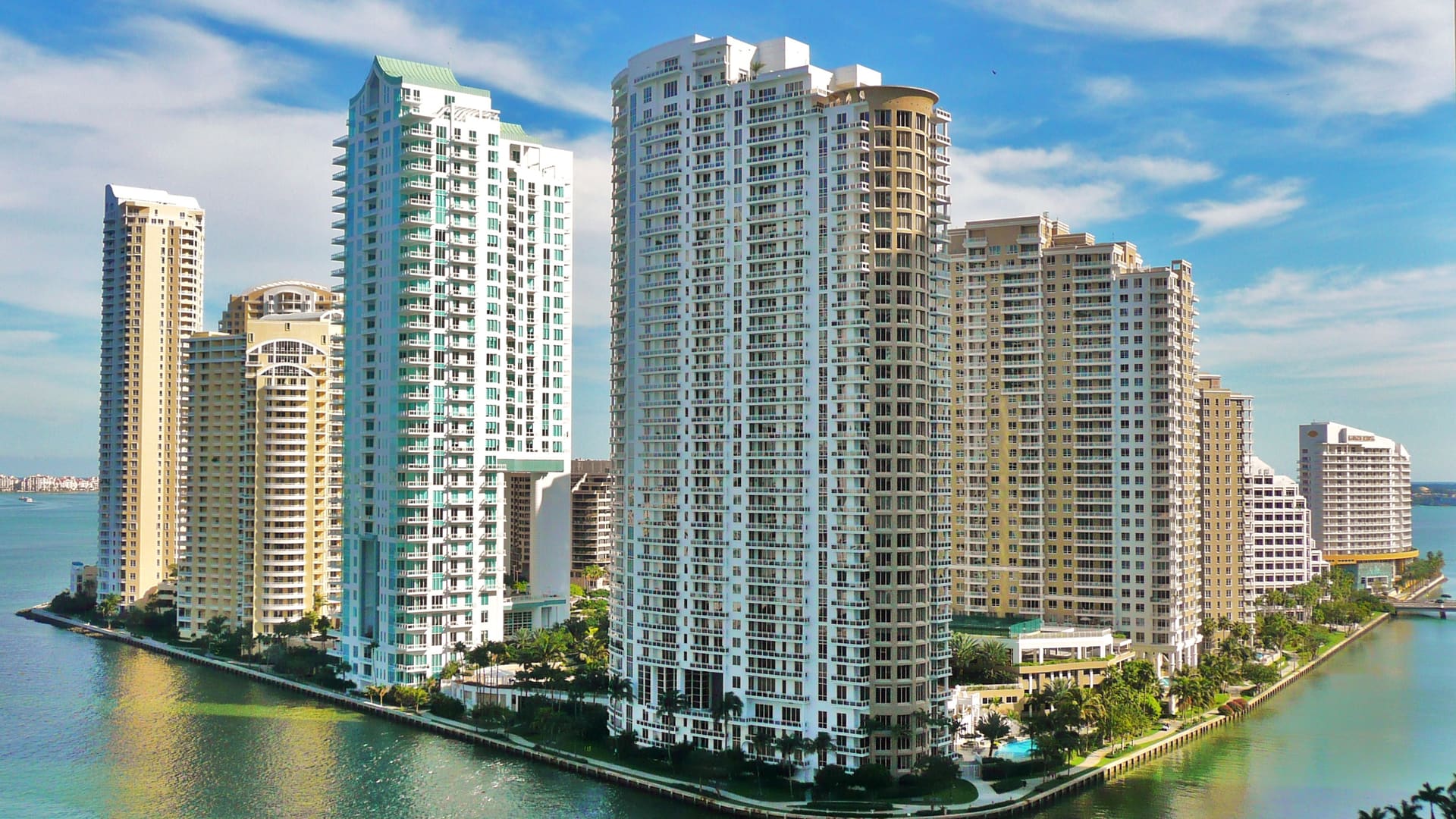
I get some version of this question almost every week: “Is Brickell Key part of Brickell?” The short answer is no. They’re two different markets that happen to share a name and a bridge. The longer answer is that the difference matters a lot depending on what you’re actually looking for, and I’ve watched more than one buyer fall in love with a listing photo without realizing which side of the water it was on.
So here’s the real comparison, not the marketing version.
What Is Brickell Key?
Brickell Key is a 44-acre man-made island in Biscayne Bay, connected to the mainland by exactly one bridge. That single point of access is the whole personality of the place: it’s the only private, gated island residential community in Miami’s urban core, with water on every side and 24-hour security at the one road in. Eleven residential buildings hold roughly 3,000 units total, with condos ranging from around $400K studios to $10M+ penthouses. The Mandarin Oriental hotel, and soon its second tower, anchors the island’s north end.
Because it’s an island, it’s small. You can walk the perimeter in under 30 minutes. Everyone recognizes everyone at the dog park. There’s a Publix, a handful of restaurants, and that’s genuinely most of the retail. For anything else, you cross the bridge.
What Is Brickell (the Neighborhood)?
Brickell is Miami’s financial district and, for the last two decades, its biggest high-rise residential boom: dozens of towers along Brickell Avenue and the surrounding grid, from the Miami River up past the Rickenbacker Causeway on-ramp. It’s dense, it’s walkable in a very different way (blocks of retail, bars, and restaurants at street level, not a marina and a Publix), and it’s connected to the rest of Miami by Metrorail, Metromover, and several arterial roads. There’s no single bottleneck the way Brickell Key has its bridge.
It’s also a much bigger, more varied market. Building ages range from early-2000s towers to new construction delivering this year. Price points span from more accessible studios and one-bedrooms up through the same ultra-luxury tier you’ll find on the island.
What’s the Real Difference Between Brickell Key and Brickell?
Access and traffic. Brickell Key’s one bridge is a feature and a trade-off in the same breath. It’s exactly what keeps the island quiet and gated, and it’s also the only way in or out, so there’s no alternate route if that road is ever backed up. Brickell has multiple ways in and out, but that also means through-traffic on the avenues that Brickell Key simply doesn’t have.
Noise and privacy. This is the biggest lifestyle difference, full stop. Brickell Key is genuinely quiet at night: no bar noise, no street traffic past the guardhouse, water views instead of building-to-building views on most exposures. Brickell has real nightlife, which is exactly what a lot of buyers want and exactly what sends other buyers looking for the bridge.
Walkability. Both are walkable, but to different things. On Brickell Key you’re walking to the water, to your neighbors, to a handful of restaurants. In Brickell you’re walking to Mary Brickell Village, to dozens of restaurants and bars, to the Metromover, a much more “urban downtown” walkability than an island one.
HOA fees and building age. This varies building to building on both sides, so it’s worth running actual numbers for a specific building rather than generalizing. As a rule, older Brickell Key buildings can carry higher fees relative to unit size than comparably aged Brickell stock, largely because of the island’s shared infrastructure and milestone-inspection and reserve-funding requirements hitting older waterfront buildings statewide. Newer construction on both sides tends to front-load amenities into the fee regardless of location.
Inventory and price range. Brickell has more listings, more price points, and more new construction in the pipeline at any given time; it’s simply a bigger market. Brickell Key’s inventory is smaller and more concentrated, which tends to support pricing when demand is steady, but it also means fewer options if you have a very specific unit type in mind. See current market report data for where Brickell Key’s numbers stand right now.
At a Glance
| Factor | Brickell Key | Brickell |
|---|---|---|
| Access | Single bridge, gated, 24-hour security | Multiple roads, no single bottleneck |
| Noise & privacy | Quiet at night, no street or bar noise | Real nightlife, more street traffic |
| Walkability | To the water, neighbors, a handful of restaurants | To Mary Brickell Village, dozens of restaurants and bars |
| Transit | No Metrorail or Metromover on the island | Served by Metrorail, Metromover, and arterial roads |
| HOA fees | Varies; older towers can run higher relative to unit size | Varies; newer towers often front-load amenities into the fee |
| Inventory | ~3,000 units across 11 buildings, roughly $400K to $10M+ | Larger, more price points, more new construction in the pipeline |
How to Decide Between Brickell Key and Brickell
- List your top three daily-life priorities. Quiet versus nightlife, walk-to-water versus walk-to-retail, and gated privacy versus transit access all pull in different directions.
- Tour both at night, not just during the day. Noise is the single biggest difference between the two, and it’s not visible in daytime photos.
- Compare HOA fees for your actual shortlist, not a neighborhood average. Fees vary enough building to building on both sides that averages aren’t useful for a real decision.
- Decide how much you value a single road in and out. Some buyers love the predictability and security; others find it limiting if that road is ever backed up.
- Check current inventory on both sides in the buildings guide or live listings before committing to tour only one area.
Which One Is Right for You, Brickell Key or Brickell?
If you want walkable urban energy, restaurants and bars downstairs, more building and price options, and better transit connections, Brickell is the better fit, and there’s no reason to pay an island premium for a lifestyle you’re not going to use.
If you want quiet, water views on multiple sides, a real sense of knowing your neighbors, and you’re willing to trade some retail variety and transit convenience for privacy and gated security, Brickell Key is very hard to replace. There’s nowhere else in Miami’s urban core quite like it.
I represent buyers, sellers, landlords, and tenants on both sides of that bridge, so I don’t have a reason to steer anyone one way or the other. If you’re not sure which fits, that’s exactly the kind of conversation worth having before you start touring. Reach out and we’ll figure out which one actually matches how you want to live, not just which one you saw first.